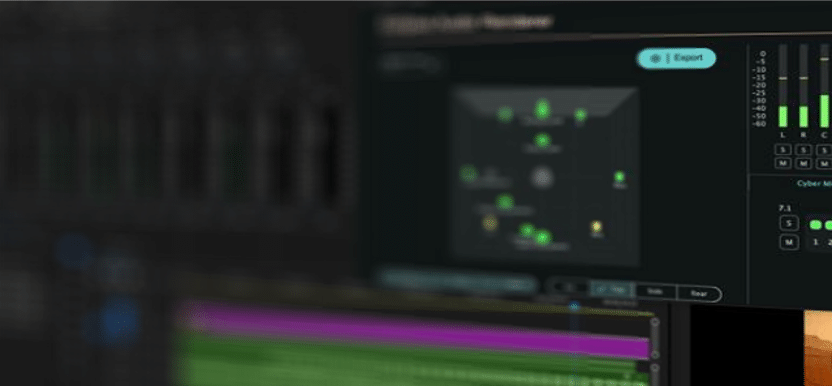
A brand-new audio file format existed on paper, but no tool could actually record into it. Before Google could offer spatial audio to creators, someone had to build the first plugin that made the format usable.
Client
Google was building support for a new spatial audio format called Eclipsa Audio, based on a new open standard for recording surround sound. Since the format was brand new, no recording tools for it existed yet. Rather than build an entirely new app, Google wanted a plugin that let audio engineers record in this format using software they already knew, starting with Pro Tools, a tool trusted by many senior audio engineers.
Challenge
There was no existing tool for recording in this new format, and the format itself was complex enough that hiding that complexity from users would matter as much as making it work at all. Google needed a plugin that felt natural to professional audio engineers, performed reliably, and could prove out whether the new format would hold up in real studio conditions.
Solution
We started by talking directly to the audio engineers who’d actually use the plugin, learning what tools they already relied on and where those tools fell short, then designed around those needs instead of guessing. We built two connected plugins, one for placing sound in 3D space and one for recording everything into the new file format, with both talking to each other in real time so engineers could monitor exactly what they were creating. We also handled the certification and signing process required to get the plugin running safely inside Pro Tools.
Results
A Working Recorder for a Format That Didn’t Exist Yet.
Google had a functioning plugin that could record real spatial audio into the new Eclipsa Audio format, tested and validated by their own team and ready to move into distribution. We’re now helping prepare it for wider release and supporting the next version of the format standard. This phase of the project continued into a second one, extending the plugin to more editing tools, covered in a separate case study.
Technical Details
Built two connected JUCE-based plugins: an Audio Element plugin for spatial placement and a Renderer plugin for recording, communicating over a Publish/Subscribe model built with JUCE and ZeroMQ. Used a 5th-order ambisonics mix bus to keep each audio element’s channels separate inside Pro Tools’ internal mixing, and a custom matrix-multiplication system for low-latency upmixing and downmixing between speaker layouts. Wrote output using IAMF-format libraries alongside JUCE, and completed Pro Tools and Apple developer signing and certification for installer distribution.
What’s Next
Google moved quickly from a finished MVP into preparing for wider distribution. We’re helping build that distribution process, alongside user-facing documentation, gathering feedback from audio engineers, and updating the plugin to support the newest changes to the IAMF standard.
Building the First Tool for Something That Doesn’t Exist Yet?
If you’re turning a brand-new spec or format into a real, usable product, we can help you build the first version right.
Date
11/2024
Languages
C++
Frameworks
JUCE
Protobuf
ZeroMQ
iamf-tools
OBR
Tools
Visual Studio Code
Avid ProTools
Environment
MacOS
Discuss Your Project
Great things happen when good people connect. Leave us your details, and we’ll get back to you.
By sending the information in this form, you agree to have your personal data processed according to A-CX’s Privacy Policy and Cookie Policy to handle the request and respond to it.
Related Case Studies

Show Up Online: An Agentic Website Business
Creating a website for a small local contractor costs more than the website is worth, which is why so many of them still do not have one. Closing that gap took AI website generation built into an outreach and delivery engine where the only thing that grows with volume is…

Apple Vision Pro: A Virtual Theater
A-CX partnered with Scene Partners to build StagePlay, an Apple Vision Pro app that puts audiences inside a virtual theater for live and recorded performances. Delivered end-to-end on a fixed schedule, the app debuted with Blue Man Group in December 2025 as the first virtual reality theater experience of its…

Google: Bringing Spatial Audio to REAPER and Adobe Premiere Pro
A‑CX partnered with Google to extend Eclipsa Audio’s reach by enabling spatial audio plugins on REAPER and Adobe Premiere Pro. We ported the original AAX plugin to VST3 and AU using JUCE, resolved complex multichannel routing and export timing issues, and stabilized IAMF workflows. Alongside the technical work, we automated…