
From Prototype to Production with A-CX AI Nexus
Agents, agentic solutions, and vibe-coded applications are everywhere nowadays and as they proliferate organizations are struggling to create a coherent agentic AI governance strategy. We’re seeing more and more organizations replacing SaaS services with internal software and automating workflows with internal agents and these replacement tools are quite powerful. This power comes from the fact that no one understands the problems a company faces better than its own employees, and so no one is better positioned to fix processes and automate work than those same employees. One of the persistent limitations of traditional software development is that development teams are often made up of developers who need to learn about the domain they are building in. But with new agentic tools companies can enable employees who were not traditionally developers but who are already experts in their domains to build the software they need. This new process of enabling non-developer employees to build agents and software is quickly becoming the hallmark of a sound agentic AI governance strategy.
We talk to a lot of companies, and the ones finding success are the ones providing easy ways for to their domain expert employees to build small automations, prototype apps, and create tools to support their work. But over and over, we see the same challenges with this type of software: governance, monitoring, and scalability issues leading to the proliferation of small, unmaintainable applications and resulting in reliability and data management risks.
These are all challenges that development teams are already intimately familiar with. What this means is that companies need to rethink how software development works. Rather than having development teams build in isolation, organizations can now fully prototype and realize their own software. Then development teams can step in to make those prototypes production-ready.
Prototypes in Action
We see the employees building the same types of applications again and again:
- Desktop or web apps built to replace SaaS tools. These can be quite powerful, but need real backend support before they can be deployed at scale.
- Agents and reports built using Claude Code or other AI tools. These work well for a single user but quickly lead to users sharing prompts and connection secrets, or handling cryptic errors by retrying and burning tokens.
- Agentic workflows built on tools like N8N, Microsoft Copilot Studio, or LangChain. These may work well for one person or a small team but do not scale across the organization.
These applications share a few things in common. They are powerful, highly specialized tools that increase productivity, improve processes, and make employees lives easier. But they are also difficult to distribute and often contain security gaps. Without an agentic AI governance plan and the supporting technology in place, these tools proliferate until it becomes impossible to know how many exist, what they access, or what they depend on. Organizations become reluctant to change data or processes because they do not know which agents or applications rely on these dependencies.
From Employee Prototype to Production
What does it take to bring these agents and applications to production? Organizations with strong agentic AI governance plans still need to address:
- Managing data access: Knowing which tools access what data and what credentials are in use. Per-app credentials can get leaked, and users who power apps with their own credentials often end up distributing them across the organization.
- Monitoring: Tracking what data is being accessed, what tools are active, and what needs maintenance. For many applications, audit trails are critical. For agents, token monitoring and budget limits are essential.
- Managing state: Central sites for agents and applications to store information prevents data silos from forming across the organization. Shared prompt libraries ensure all agents operate with a consistent set of core rules.
- Reliable and scalable deployment: Prototype applications prioritize usability over reliability, resulting in things like local databases which don’t scale. Similarly, building a web app may be easy now but deploying updates to it reliably or ensuring it is secure are different sorts of problems. Often these problems are not considered upfront during prototyping.
These are challenges that development teams have always handled. Developers have straightforward, well-understood ways to solve them. At A-CX, we built a set of libraries to do exactly that. We call it the A-CX AI Nexus.
What Is the A-CX AI Nexus?
A-CX AI Nexus is a set of cloud and LLM agnostic libraries and tools we provide to organizations to help move prototypes to production and provide tangible grounding for agentic AI governance. That is it.
The idea behind A-CX AI Nexus is to provide an easy drop-in solution for building production-grade agents and applications. A-CX AI Nexus provides a control plane from which applications can be deployed with confidence: data access is secure, actions are monitored, and there is a central point from which applications can be scaled and their state managed. Depending on the client, A-CX AI Nexus may provide the entire agentic AI governance structure for an organization, or just one part of it.
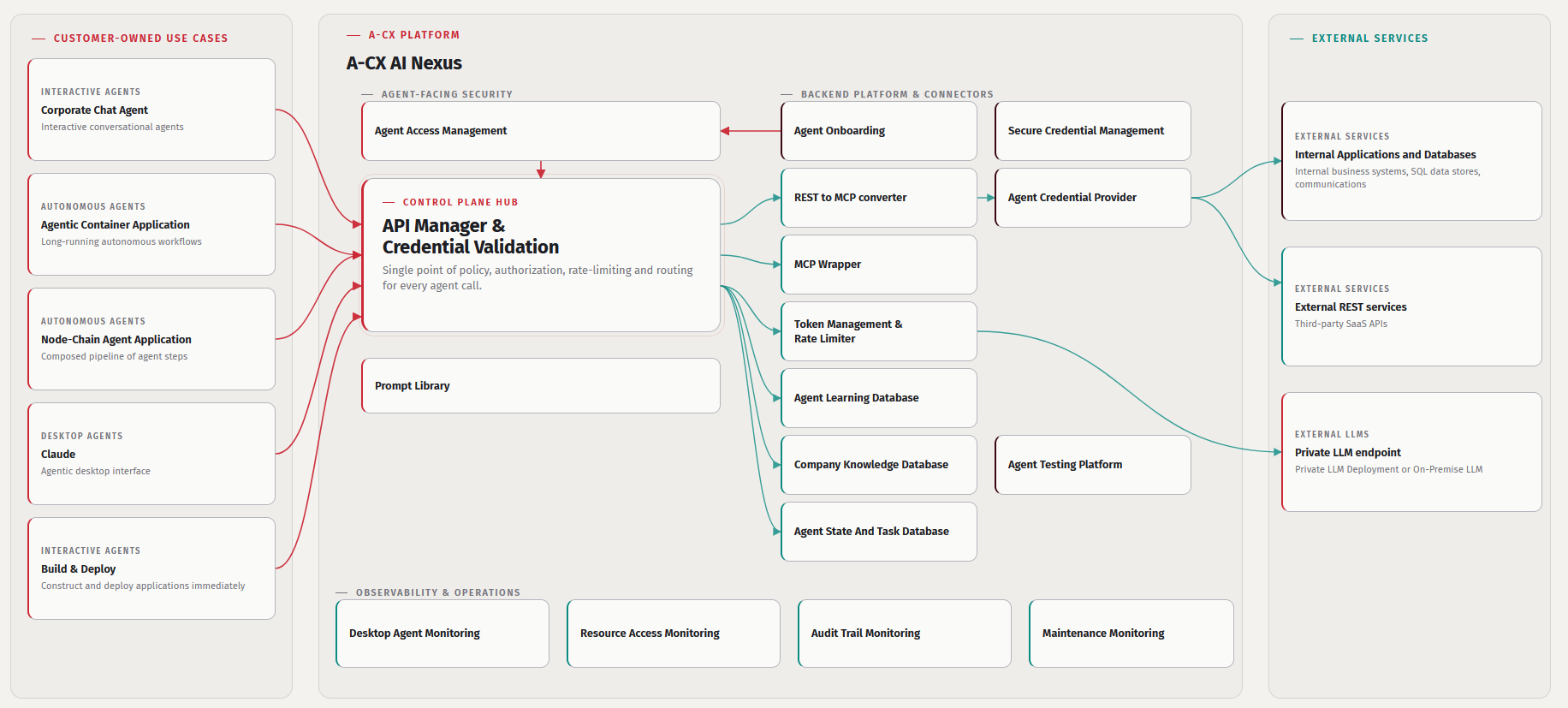
No one component of A-CX AI Nexus is unique in isolation. Cloud providers already offer monitoring, audit logging, databases and more to help build production grade software and the A-CX AI Nexus makes liberal use of these tools. What A-CX AI Nexus provides is the glue. It is a governance control plane built on top of cloud infrastructure from which applications can be deployed, and is tightly integrated with the cloud provider tools. Having a control plane in place helps employees develop faster, because they, and their agents, have known, secure, reliable patterns to build on.
What’s Next
Software development is changing. Organizations are finding that their most capable builders are often not developers at all, but employees who understand exactly what needs to be built and now have the tools to build it. However, at A-CX, we have seen that the core challenges of software delivery are not going anywhere. While it is becoming easier to build software, the fundamental challenges of security, reliability, monitoring, and scalability are still causing organizations challenges. In the coming weeks, we will be publishing posts that go deeper on each of these challenges and how A-CX and the A-CX AI Nexus can help teams address these challenges.
